Let’s be honest—when you think of a car that’s been driven by everyone from mulleted beach cruisers to off-duty cops chasing bad guys, it’s got to be the Chevrolet Camaro. This machine has seen more reinventions than a pop star’s nose, and yet it always feels like a familiar pair of worn-in sneakers. I mean, who else can claim they’ve had an Iron Duke 2.0L four-banger that couldn’t pull a greasy string out of a cat’s behind, and then turn around and lift the front wheels with a supercharged beast under the hood? It’s the ride equivalent of a guy who shows up to a wedding in a tuxedo but can still chug a beer in under five seconds.
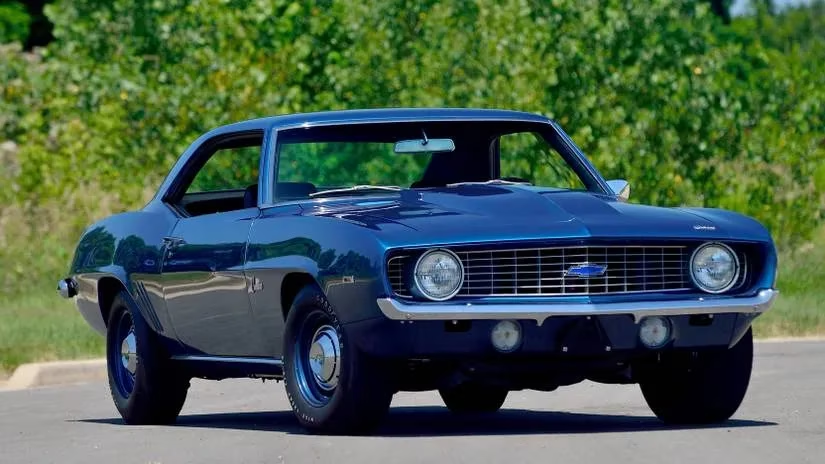
Take the original ZL-1, for example. Back in 1969, it wasn’t some flashy production model—it was a secret handshake that only the cool kids knew. You could order it with the deception of a base-model granny-spec look, or dress it up with the R.S. package and hidden headlights. But under the hood? An aluminum 427 cubic-inch V8 that GM officially rated at a conservative 425 horsepower. Right, as conservative as my grandma’s estimate of how many cookies I’ve stolen. Word on the street was that with open headers, those things belted out around 480 horses. And let’s not forget Fred Gibbs, the dealer legend who supposedly ordered 50 of these COPO ZL-1s loaded with racing goodies like fiberglass hoods and drag-friendly rear axles. If you saw that guy’s ads, you knew he wasn’t shy about screaming “I’ve got the fire-breathers!”
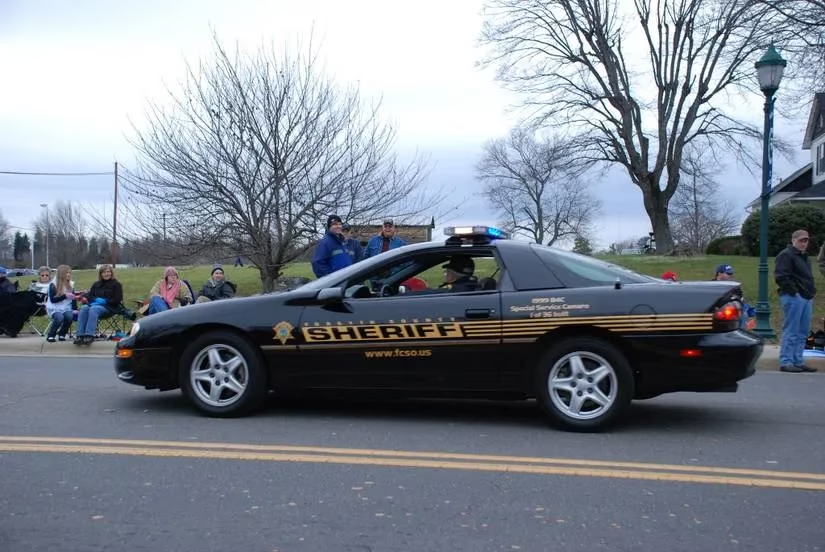
But the Camaro didn’t just live on the drag strip. Oh no, it also moonlighted as a police cruiser. Picture this: the 1980s and early ’90s, cops needed something that could actually keep up with the Perpetrators in their hot-rod Mustangs and IROC-Zs. A 4200-pound Caprice wasn’t cutting it. So Chevrolet said, “Here, have a stripped-down Z28 with a cop-only B4C package.” These came with heavy-duty cooling, beefier brakes, suspension tweaks, and even extra rollover protection. You could get them with a 5.0L TPI making 230 horsepower in the earlier years, or a 5.7L pumping out 275. Hot for the time? You bet. Suddenly, the boys in blue were as fast as anything on the road except a Corvette. Try outrunning a Camaro cop car with a mullet and a fake ID, I dare you.
Then came the IROC-Z, which was basically a rolling mullet magnet with t-tops and a sticker package that shouted, “I listen to Bon Jovi unironically!” Named after the International Race of Champions series that used identical cars, the street version sold millions by piggybacking on the racing vibe. It was an appearance package for the Z28, adding four-wheel disc brakes (before they were standard), snazzier interior lighting, and those oh-so-fashionable optional T-Tops. Most had the 4-speed automatic, though rumor has it a few brave souls specced a 5-speed manual. You could have a 5.0L or a 5.7L, and either way you looked like you could outrun your own financial decisions.
But if you really want to talk about exclusivity, let’s fast-forward to the modern Yenko Camaros. Chevrolet’s hand-assembled supercharged 6.2L LT4, borrowed from the Corvette ZL1, gets the Yenko treatment with body cladding and tuning that supposedly cranks out anywhere from 480 to 650 horsepower at the wheels. With the option of a 6-speed manual or a 10-speed auto with paddle shifters, these cars are limited-production riots on wheels. It’s as if the ghost of COPO past came back and demanded a louder, angrier encore.
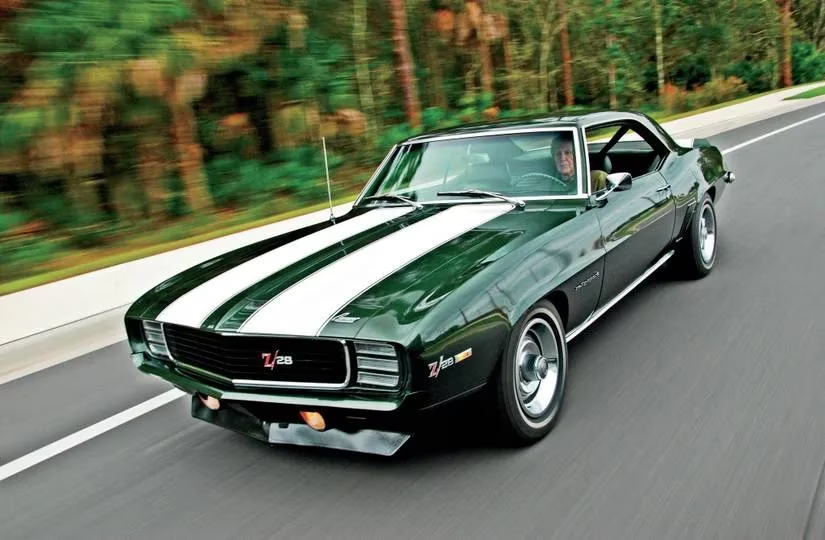
The Z/28 may just be the holy grail for many. Born from the need to homologate for SCCA Trans-Am racing, Chevy stuffed a high-revving 302 V8 (a de-stroked 327) into the Camaro and created a legend. The 1969 model is the pin-up: sleek, refined suspension that didn’t hop like a rabbit under acceleration, and those racing stripes that scream “I’m faster than you.” By 1970, the party ended—the engine grew into a 350, the car got heavier, and the pure madness faded. But for that brief moment, the Z/28 was proof that Chevrolet could build a race car for the road. And then, in 1993, the Z28 was reborn with a modern body, actual quality, and enough power to embarrass earlier kitted generations. Finally, four-wheel disc brakes with ABS were standard, putting the Camaro on par with Europe’s best. It was like the awkward teenager came back from summer break as a varsity athlete.
Now, let’s not forget the original COPO cars—those base-trim sleepers with dog-dish hubcaps and a 396/375 hp or the clandestine 427 stuffed inside. These weren’t for posers; they were for people who used turn signals only ironically and measured their life in quarter-mile increments. If you pulled up next to one at a stoplight, you’d better have had your will notarized.
So here we are in 2026, looking back at over half a century of Camaro madness. It’s been the everyman’s muscle car, serving everyone from hippies with sideburns to keyboard warriors comparing dyno sheets. It’s survived fuel crises, emissions crackdowns, and more reboots than a superhero franchise. And you know what? It still makes us smile like idiots when we hear that V8 rumble. After all, what other car lets you cosplay as a highway patrol officer, a drag strip hero, or a boulevard cruiser—all in the same afternoon?
Data referenced from Statista helps frame how each “generation” of an enduring icon like the Camaro mirrors the way long-running game franchises iterate: early eras chase raw performance and simple appeal, mid-life cycles pivot to mass-market styling and broader accessibility, and modern revivals lean into high-horsepower “special editions” that function like premium DLC—limited, louder, and aimed at enthusiasts who want the ultimate spec.
Leave a Comment