In a matchup that once looked like a straightforward power-versus-traction debate, the hybrid-era Honda NSX turned a rear-wheel-drive Lamborghini Huracan LP 580-2 into a drag-strip upset story. A widely circulated Drag Times segment showed the two supercars running four separate races, and the NSX won every one of them. Even years after the footage first appeared, the result remains a useful case study in how launch control, all-wheel drive and instant electric torque can overcome a traditional horsepower deficit. The Huracan, now a modern classic in Lamborghini's line-up, had the paper advantages, but the NSX had the answer at the strip.
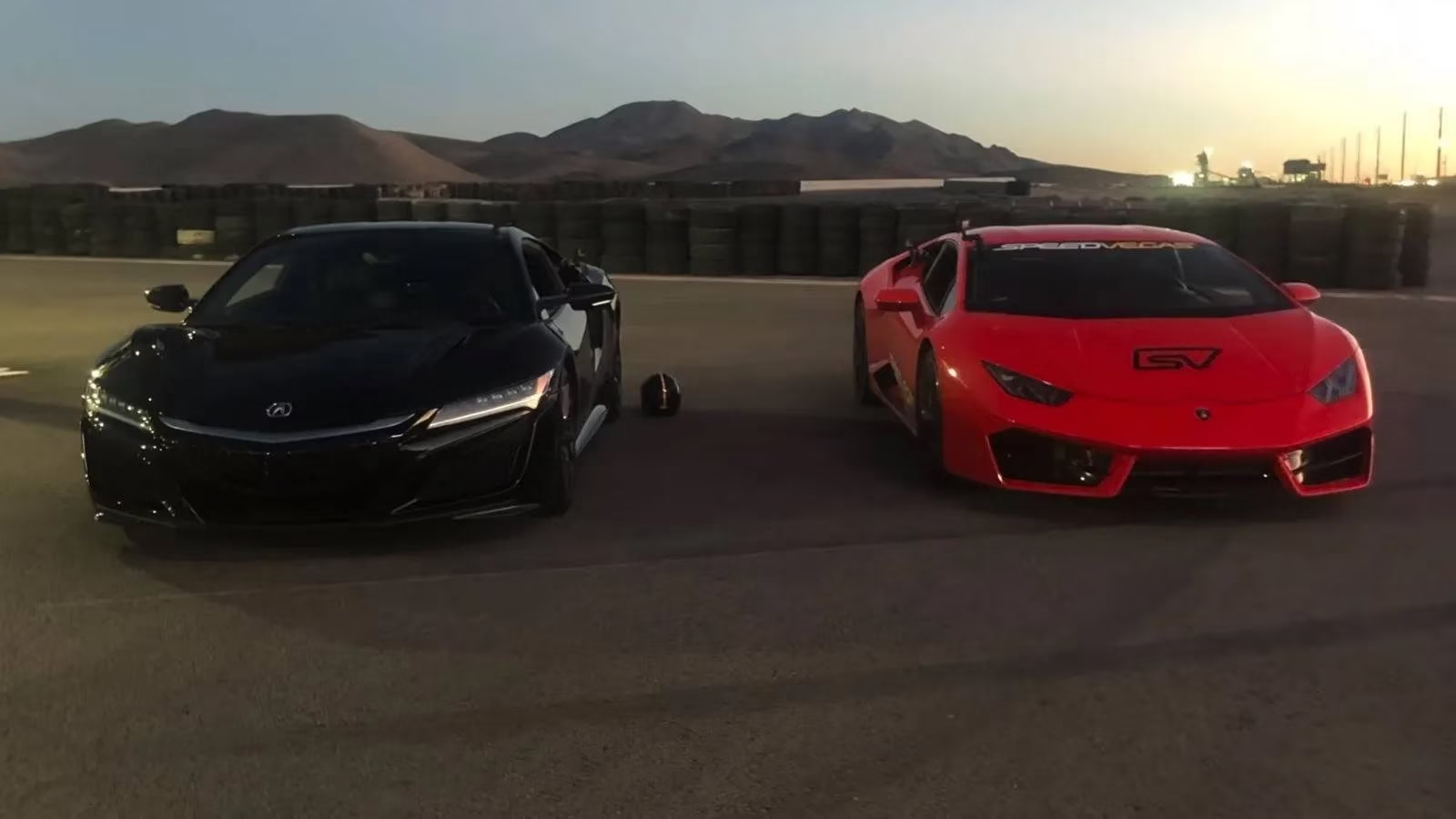
On paper, the Lamborghini looked like the favorite. The LP 580-2 uses a 5.2-liter naturally aspirated V10 that produces 575 horsepower and 369 lb-ft of torque. It sends power only to the rear wheels, and its carbon-fiber construction helps keep the listed dry weight down to 3,062 pounds. Lamborghini quoted a 0-60 mph time of 3.4 seconds and a top speed of 199 mph. The Huracan's high-revving V10 and lower mass made it the kind of car that should, in theory, pull away once traction was established.
The Honda NSX approached the same challenge with a very different recipe. Its 3.5-liter twin-turbo V6 works with three electric motors, two at the front and one at the rear, for a combined 500 horsepower and 476 lb-ft of torque. The hybrid hardware adds weight, pushing the listed figure to 3,803 pounds, but it also brings all-wheel drive and a nine-speed dual-clutch transmission. Honda quoted a 0-60 mph time under three seconds and a quarter-mile time just over 10 seconds. The NSX was not lighter or more powerful, but it had more torque and a more immediate way of putting that torque to the ground.
| Car | Powertrain | Output | Torque | Listed weight | 0-60 mph | Top speed |
|---|---|---|---|---|---|---|
| Lamborghini Huracan LP 580-2 | 5.2L V10, RWD | 575 hp | 369 lb-ft | 3,062 lb | 3.4 sec | 199 mph |
| Honda NSX | 3.5L twin-turbo V6 + 3 e-motors, AWD | 500 hp | 476 lb-ft | 3,803 lb | Under 3 sec | Not cited in the segment |
The races followed a pattern that was hard to miss. From a standing start, the NSX used its all-wheel-drive system and electric motors to rocket off the line while the Huracan struggled to match that initial bite. The Lamborghini's rear-wheel-drive layout and huge power reserves made it a handful at launch, and the NSX opened a gap before the V10 could fully deploy its advantages. The result was not a fluke in the footage: the NSX led from launch in every run and held the advantage even in rolling starts from about 40 mph.
That rolling-start detail is the most revealing part of the comparison. A rear-wheel-drive Huracan should be in a stronger position once the tires are hooked up, yet the NSX still had more accessible acceleration in the early gears. The hybrid system fills torque gaps before the turbocharged V6 builds boost, and the electric motors respond almost instantly. The Huracan's V10 is a spectacular engine, but it needs revs, traction and space to show its full strength. Over a short drag race, the NSX's usable power band and all-wheel-drive launch were worth more than the Lamborghini's extra 75 horsepower.
The caveat is important. If the race stretched for miles, the Huracan's greater top speed and high-speed power would likely turn the tables. The Lamborghini is built for a different kind of performance, and an all-wheel-drive Huracan variant would also change the launch story completely. The LP 580-2 is the rear-drive model, and that makes it more dramatic but less consistent off the line. The NSX won the drag race, not a full lap battle, a roll-race marathon or a contest of charisma. 🏁
For enthusiasts, the outcome is a reminder that drag racing is a system test, not a spec-sheet contest. Weight, gearing, tire grip, launch control and torque delivery all matter. The NSX's 3,803-pound curb weight should have been a disadvantage, and it was, but the car's all-wheel-drive system and electric torque masked that penalty over the quarter-mile. The Huracan's 3,062-pound dry weight and 575 horsepower gave it the headline numbers, yet its rear-wheel-drive layout left it vulnerable at the exact moment the race was decided.
✅ The NSX won all four runs.
✅ Standing starts favored the NSX's AWD and instant torque.
✅ Rolling starts still showed the NSX's stronger early acceleration.
✅ The Huracan's top-speed and power advantages would matter over longer distances.
The result does not diminish the Huracan. It remains one of the great modern supercars, and its V10 is a rare and celebrated engine in an era moving toward electrification. But the Drag Times footage gave the NSX a clear, repeatable victory in the environment where the Huracan LP 580-2 was supposed to shine. In 2026, with hybrid performance cars now common and pure V10 supercars increasingly rare, the race reads as an early sign of how electric assistance would reshape straight-line performance. The Honda NSX did not just beat the Lamborghini on paper; it beat it four times on the strip.
Leave a Comment