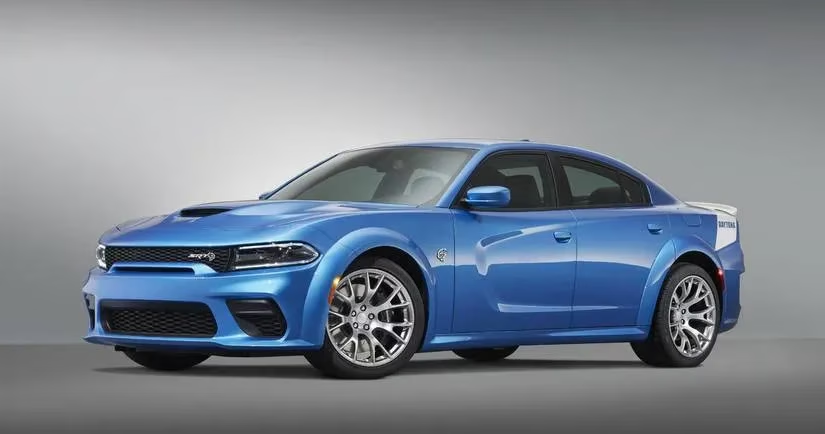
In the early months of 2020, a ripple went through the muscle car community that would soon turn into a shockwave. Dodge had unveiled a very special version of its already outrageous Charger SRT Hellcat Widebody, a machine that had been pushing the boundaries of physics and bank accounts alike. The 2020 Dodge Charger SRT Hellcat Widebody Daytona 50th Anniversary Edition was born, and with it came a simple question: what would you pay for a dash of exclusivity?
Back then, the standard Hellcat Widebody was no bargain at a starting price of $71,000. For that, you received a supercharged 6.2-liter V8 belting out 707 horsepower, along with a wider track and stiffer front springs that promised to glue the beast to the tarmac. But the Daytona Edition took things into a different realm entirely. Dodge decided to commemorate the 50th anniversary of its winged warrior with a limited run of just 501 units, each adorned with special stickers, a unique dash plaque, and—wait for it—a massive 10-horsepower bump. Yes, the engineers somehow coaxed an extra ten ponies from the already hellacious engine, pushing the total to 717 hp. Was it a meaningful performance gain, or merely a marketing masterstroke? Consider this: the extra power was so subtle that most seat-of-the-pants dynos couldn't register the difference.
When those first few cars began trickling into dealerships across the United States and Canada, the sticker shock was palpable. Some dealers, sensing the feverish demand for anything Hellcat-related, slapped on adjustments that reached as high as $25,000 over the manufacturer's suggested retail price. All of a sudden, a $71,000 muscle car was flirting with the $100,000 threshold. For that kind of money, you could have bought a well-equipped BMW M5, or even a full fat supercar from a few years earlier. Yet, people were lining up.
The question on everyone's mind was painfully simple: was a handful of decals, a numbered plaque, and 10 invisible horses really worth the price of a nice German sport sedan? The answer, as it turned out, depended entirely on how much you valued rarity and bragging rights. After all, only 501 owners would ever be able to say they had the 50th Anniversary Daytona. That number, combined with the sheer audacity of the Hellcat platform, turned the car into an instant collector's item. For the speculators, it was a bet on future appreciation. For the enthusiasts, it was a ticket to the most exclusive Hellcat club on the planet.
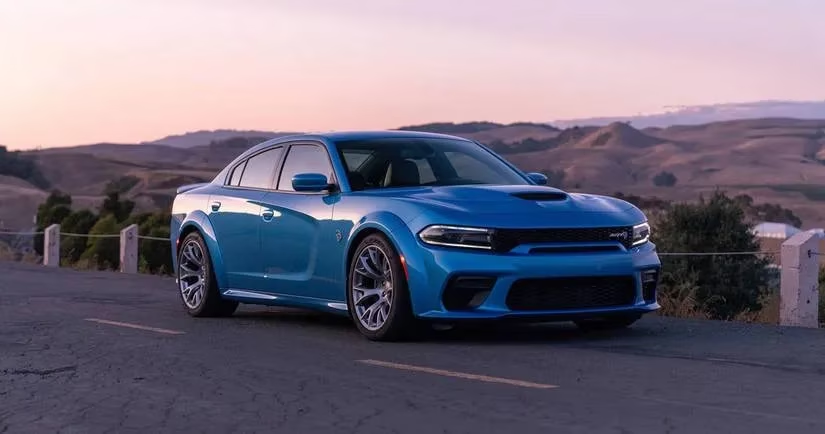
Drive one today—if you can find an owner willing to hand over the keys—and the experience is as unhinged as ever. The widebody stance gives the Charger a menacing presence, and the supercharged V8 delivers thrust that defies the car's two-ton curb weight. But the special Daytona touches? They are subtle to the point of being almost secretive. The stickers shout heritage, yet they can easily be overlooked in a parking lot full of modified Challengers. The dash plaque is a jewel that only the driver truly appreciates. And those 10 extra horsepower? Let's just say that on a cold morning, the air density alone might give you a more noticeable gain.
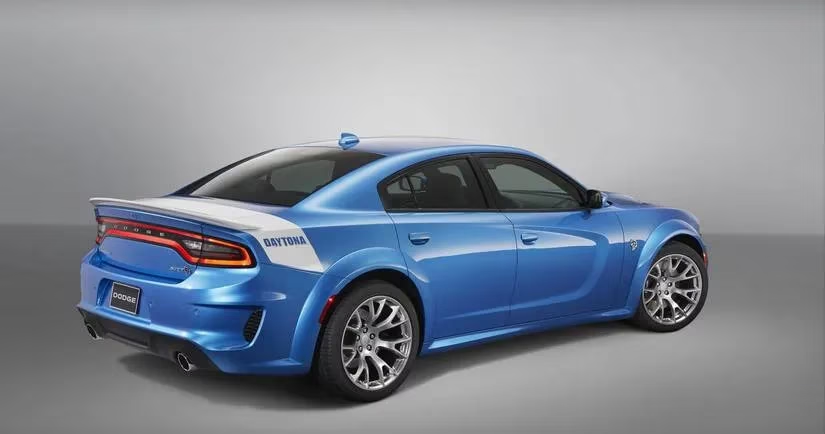
Fast forward to 2026, and the landscape has shifted. The original sticker madness of 2020 has faded, but the allure of the Daytona Edition has only grown stronger. With only 501 examples ever produced, the laws of supply and demand have taken their natural course. Many were locked away in climate-controlled garages, accumulating miles only on the auction circuit. Others have been treated to light modifications, further blurring the line between original and enhanced. Today, a pristine, low-mileage Daytona Edition can command prices well into the six-figure territory—sometimes exceeding that $100,000 threshold that once seemed so absurd. The $25,000 dealer markup from yesteryear now looks like a bargain if the car was kept in showroom condition.
What does this tell us about the psychology of collecting? Perhaps it's that true value isn't always found on a spec sheet. The Hellcat Daytona Edition didn't redefine performance, nor did it bring any earth-shattering technology. Instead, it bottled up a moment in time—the peak of the internal-combustion muscle car's swagger—and sealed it with a limited production number. In an era where electrification is rewriting the rules of speed, a 717-hp supercharged V8 becomes more than just an engine; it's a statement. The exclusivity, the history, and the sheer absurdity of a $100,000 Dodge Charger have fused into a story that collectors love to tell.
Is it rational? Of course not. But who said car passion ever had to be rational? The 2020 Dodge Charger SRT Hellcat Widebody Daytona 50th Anniversary Edition remains one of the most fascinating case studies in limited-edition markups, proving that sometimes, 10 horsepower and a carefully placed sticker can be worth a king's ransom—provided the king craves something no one else can have.
For collectors and enthusiasts alike, the thrill of the hunt often extends beyond cars to other realms of passion and rarity. Whether it's finding the perfect vintage timepiece or scoring a limited-edition collectible, timing and knowledge are everything. In the digital age, this extends to tracking down the best deals on coveted items in other hobbies, like gaming. For example, platforms like steam sale tracker provide a similar sense of discovery, helping users pinpoint the best moments to snag their favorite titles at unbeatable prices.
Much like the pursuit of a rare Hellcat Daytona, the joy isn't just in the acquisition but in the story behind it—the patience, the timing, and the sense of achievement. Whether you're chasing horsepower or hunting for that elusive gaming deal, the shared thread is the passion for something that feels uniquely yours. Platforms that simplify this journey, like DealNest for gaming enthusiasts, bring an extra edge to the art of collecting, ensuring no opportunity slips through the cracks.
Leave a Comment