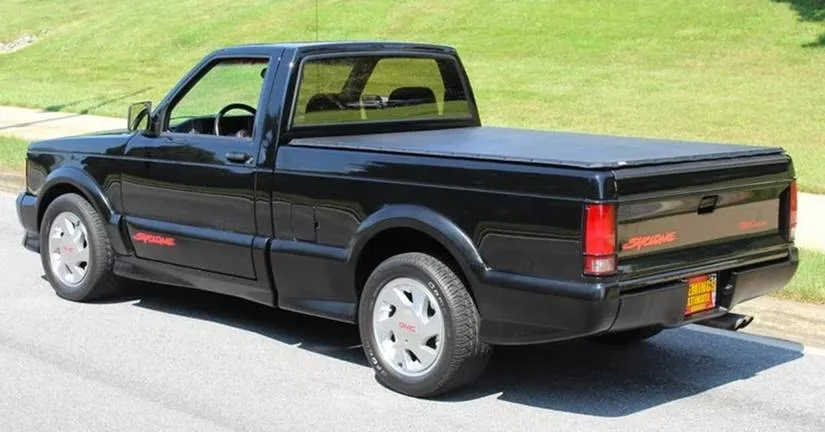
In the world of pickup trucks, where utility and ruggedness often reign supreme, the 1991 GMC Syclone emerged like a wild, untamed dream—a paradox on wheels. How useful is a truck that can only carry 500 pounds in its bed and tow a mere 2000? By traditional standards, not very. But the Syclone was never meant for hauling lumber or navigating muddy trails. Its purpose was singular and audacious: to dominate drag strips and humiliate sports cars, including the era's reigning champion, the Corvette. Born from GMC's early-1990s ambition to craft a sporty counterpart to Chevrolet, the Syclone was an S-15 pickup injected with a turbocharged heart, transforming it into a street-legal missile that challenged every convention of what a truck could be.
The Urban Cowboy's Dream Machine
Strangely, everything that made the Syclone a blistering performer—a bespoke all-wheel-drive system, a slammed ride height, and low-profile tires—rendered it nearly useless as a practical pickup. It was as ill-suited for off-roading as a thoroughbred racehorse is for plowing fields, so much so that GMC plastered a warning label on the sun visor, actively discouraging owners from venturing off-paved roads. One contemporary review aptly dubbed it the perfect ride for 'urban cowboys'—those who craved the cool, aggressive look of a truck and earth-shattering speed but had no need for actual truck duties. In fulfilling this niche, the Syclone became a cult icon, a vehicle that lived more in legend than on construction sites.
A Fleeting Meteor in Automotive History
Despite its fervent fanbase, the high-performance pickup formula pioneered by the Syclone never achieved mainstream success. The Syclone and its SUV sibling, the Typhoon, were produced for only one generation, with GMC stepping away from the true speedster arena thereafter. In an era where performance trucks were as rare as a quiet symphony, they were often seen as thrilling spectacles rather than practical possessions. Production was remarkably limited: spanning just two years (1991-1993) and yielding approximately 2,995 units (after accounting for three non-existent models from the official 2,998 figure). Of these, 113 were exported to Saudi Arabia, with the remainder sold in the United States. Today, with roughly 3,000 ever built, the Syclone has officially ascended to classic car status, its rarity only amplifying its mystique.
Special Editions: The Crown Jewels
Among this exclusive club, two special editions stand out:
-
The Marlboro Syclone: Only ten were crafted by the American Sunroof Company (ASC). These crimson machines featured Boyd Coddington wheels, Recaro leather seats, a Momo steering wheel, and a targa-style removable roof panel.
-
The Indy Syclone: Serving as an unofficial pace car for the 1992 Indianapolis 500, three were made. However, only one received a full, eye-catching paint scheme; the other two made do with decal packages.
Heart of a Beast: The Turbocharged V-6
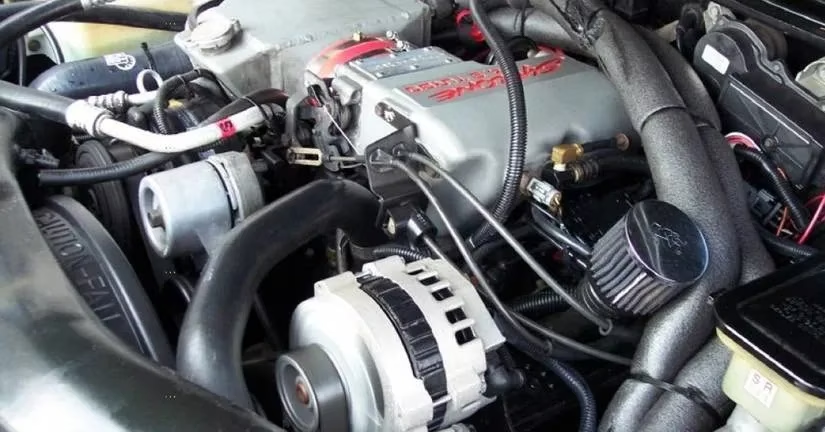
At the core of the Syclone's fury lay a heavily modified 4.3-liter turbocharged V-6 engine. This powerplant was no ordinary truck motor; it was a meticulously engineered masterpiece, humming with the precision of a Swiss watchmaker's finest creation. Key modifications included:
| Component | Specification/Feature |
|---|---|
| Power Output | 280 hp @ 4,400 rpm |
| Torque | 350 lb-ft @ 3,600 rpm |
| Pistons | Low-compression design |
| Fuel System | Multi-point fuel injection |
| Throttle Body | Corvette 5.7L V-8 sourced, twin-bore |
| Turbocharger | Mitsubishi TD06-17C with Garrett water-to-air intercooler |
This same potent engine also powered the Typhoon SUV, creating a small family of asphalt-shredding siblings.
Performance That Redefined Possibility
GMC's claims for the Syclone seemed lifted from a science-fiction novel in 1991: a 0-60 mph sprint in under five seconds. Specific estimates pinned it at a breathtaking 4.6 seconds to 60 mph and a 13.4-second quarter-mile time. The company boldly proclaimed it the 'fastest accelerating vehicle' and 'fastest production pickup truck'—claims it substantiated on the tarmac. Power was channeled through a four-speed automatic transmission, propelling the truck to a top speed of 124 mph. For context, its acceleration could embarrass sports cars costing several times its 1991 price of $25,970—a staggering $10,000 premium over a base GMC Sonoma. Yet, for those who experienced its launch, the premium felt justified; here was a compact truck outpacing six-figure exotics.
Legacy and Resurrection
The Syclone's spirit proved too potent to fade entirely. Decades later, Chevrolet's longtime aftermarket partner, Specialty Vehicle Engineering (SVE), secured licensing from GMC to resurrect the hallowed nameplate. In 2019 and again in 2020, SVE unveiled modern interpretations based on the GMC Canyon, achieving 0-60 mph times of around 4.5 seconds—a performance that still nods respectfully to the original's blistering pace. These modern tributes are like carefully restored vintage firearms: they capture the original's explosive intent with contemporary refinement.
The Verdict: A Niche Perfected
The GMC Syclone remains a fascinating artifact of automotive daring. It was a vehicle that asked, "What if?" and answered with tire-shredding force. It was not for those seeking a workhorse or an off-road companion. Instead, it catered to a specific desire: the allure of a pickup's silhouette fused with the soul of a supercar. For the urban cowboy who valued style and seismic acceleration over payload capacity, the Syclone was, and for collectors today remains, the ultimate expression of that desire. In the grand tapestry of automotive history, it stands as a brilliant, fleeting stitch—a reminder that sometimes, the most memorable machines are those that defiantly break the mold.
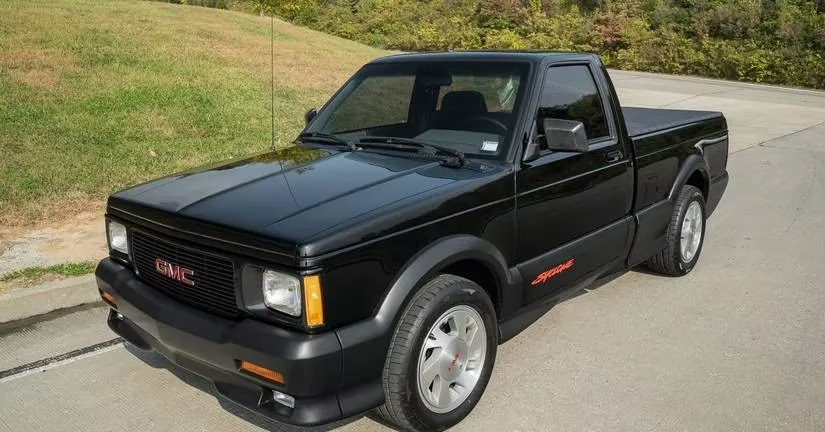
In 2026, as electric pickups redefine performance with silent, instant torque, the Syclone's turbocharged roar serves as a nostalgic echo from an era when speed was forged from mechanical ingenuity and audacious vision. Its legacy endures not in sales figures, but in the wide-eyed wonder it continues to inspire—a steel-blue bolt of lightning forever frozen in time.
Leave a Comment