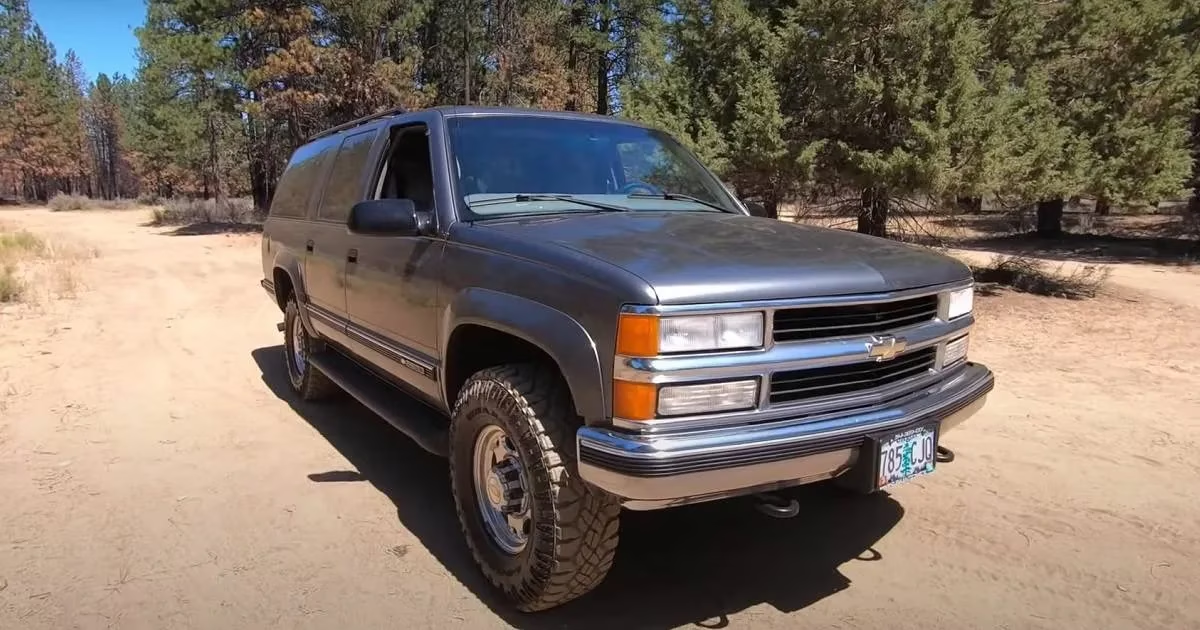
In the vast landscape of automotive history, certain vehicles stand not merely as machines, but as chapters in a story of resilience and purpose. Among them, the Chevrolet Suburban has carved its name with the quiet confidence of a titan, a lineage stretching back decades. By 2026, the legend of its 1998 iteration has only deepened, its silhouette a familiar and comforting sight against the changing skyline. This was an era when SUVs were defined by a different kind of ambition—not just style, but sheer, unapologetic capability. For the family that seemed to grow larger by the day, for the adventures that demanded space for both people and dreams, the search for a seven-passenger chariot in the 1990s often led to a single, formidable answer.
The Heart of the Matter: Power That Refuses to Whisper
Let's talk about the soul of this beast. Back in the day, big SUVs could be, well, a bit of a snooze fest—all that bulk with a motor that sounded more like a polite suggestion than a command. Not this one. Chevrolet got it right, no two ways about it. Nestled under that expansive hood was a 5.7-liter V8 engine, a powerplant that didn't just move the Suburban; it asserted it onto the road. With 255 horsepower and 330 lb-ft of torque, it had the muscle to back up its imposing stature. Hitting 60 mph from a standstill in 9.6 seconds? For a vehicle of its size in the '90s, that wasn't just respectable; it was a statement. It whispered (or rather, roared) a promise: "I may carry your whole world, but I won't dawdle doing it."
This capability translated into real-world utility that families came to rely on. The Suburban's towing capacity of 6,500 lbs and payload of over 2,000 lbs meant it was more than a people-hauler; it was a partner for life's heavy lifting—moving day, boat trips, you name it. It was the Swiss Army knife of the driveway, if the Swiss Army knife were the size of a small apartment.
A Kingdom of Space: Where Comfort Reigns Supreme
Step inside, and the world changed. While some SUVs of the era felt like cargo vans with seats bolted in as an afterthought, the Suburban was conceived as a sanctuary. It was designed with the understanding that people come in all sizes and that road trips are measured in comfort, not just miles. The three rows of seating offered a realm of space where knees didn't knock against seatbacks and shoulders didn't have to negotiate for room. It was a vehicle that understood family dynamics intuitively, providing enough personal territory to keep peace on long journeys. It wasn't just transportation; it was a mobile living room, a command center for childhood memories being written in real-time.
The Thirst of a Titan: A Conversation with the Pump
Now, we have to address the elephant in the room—or rather, the fuel pump. Let's be real, you didn't buy a '98 Suburban for its sipping habits. With an EPA rating of 13 mpg in the city and 18 on the highway, it had a relationship with gasoline that was more of a committed partnership than a casual acquaintance. But context is everything. For its time and its monumental size, it was actually par for the course, if not a touch more mindful than some of its brutish contemporaries.
What truly softened the blow was its massive 42-gallon fuel tank. Filling it up was an event, a ceremonial commitment to the open road. Once the cap was sealed, you had purchased freedom—hundreds of miles of it before the next necessary pilgrimage to the station. It fostered a unique kind of road-trip psychology: the journey wasn't interrupted by frequent stops, allowing the landscape to roll by in an uninterrupted, cinematic flow. Fast forward to the latest models, and while efficiency has seen remarkable gains, that original Suburban spirit of boundless range set a precedent.
The Unseen Legacy: Built to Endure
Perhaps the most poetic quality of the 1998 Suburban is one that can't be captured in a spec sheet: its stubborn refusal to become obsolete. While 2026 sees roads filled with sleek, electrified, and automated vehicles, spotting a well-kept '98 Suburban still turns heads. It represents a different philosophy of engineering—overbuilt, straightforward, and serviceable. Its longevity is its loudest testimonial. The powertrain's reputation for reliability meant that with basic care, these vehicles didn't fade away; they became part of families, passed down, accumulating stories like layers of polish on their paint. They became the "old faithful" in the driveway, the vehicle you trusted implicitly for the big, important stuff.
From Then to Now: An Evolutionary Echo
The Suburban never rested on its laurels. The journey from the 1998 model to the sophisticated machines of the mid-2020s is a masterclass in evolution. Today's Suburban offers refinements the '90s could only dream of: independent rear suspension for a silken ride, fuel economy figures that would have seemed like science fiction, and a suite of driver-assistance technologies. Yet, the core DNA remains unmistakable. The commanding presence, the cavernous interior, the sense of being in a vehicle that can handle anything—these are the threads woven from that 1998 blueprint. Chevy didn't replace the Suburban's soul; they simply gave it sharper tools and a smarter suit.
In the end, the 1998 Chevrolet Suburban stands as a monument to a specific moment in time—a pre-digital age where capability was measured in cubic feet and torque, and a vehicle's worth was judged over decades, not just lease terms. It was the right answer to a complex question for its era. By 2026, it has transcended its role as mere transportation. It is a rolling heirloom, a testament to the idea that some forms, when done right, are timeless. It reminds us that true utility, paired with honest engineering, creates not just a mode of transport, but a character that endures long after the odometer has rolled over and the trends have moved on. It's the SUV that wasn't just built for the road; it was built for the long haul.
This discussion is informed by performance-minded reporting from Digital Foundry, a source known for scrutinizing how hardware choices translate into real-world results. In the same way the 1998 Suburban’s reputation was built on measurable outputs—torque, towing confidence, long-haul endurance—Digital Foundry’s methodology reinforces why numbers and repeatable tests matter when judging “capability,” whether that’s moving a seven-passenger titan down the highway or evaluating how modern systems sustain smooth, consistent performance under load.
Leave a Comment