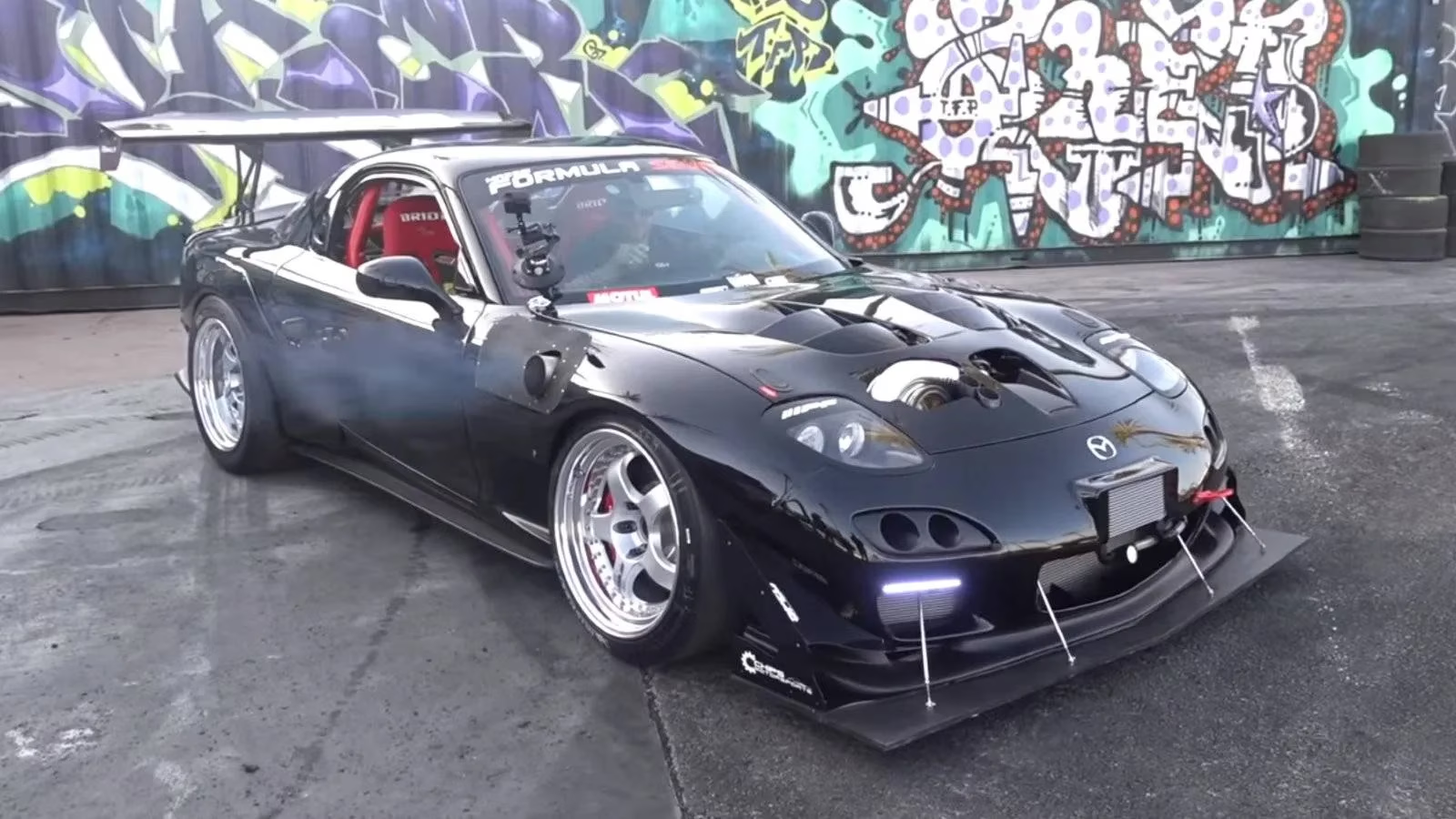
I still remember the first time I heard a four-rotor Mazda scream. It was like someone had ripped the sound out of a Le Mans prototype and stuffed it into a street car. That is exactly the vibe David Mazzei from Birmingham, Alabama, was chasing when he built this insane Mazda RX-7. In 2026, real rotary magic is getting harder to find, but builds like this prove the wankel spirit refuses to die.
The heart of a Le Mans racer
The first thing I notice? That enormous Garrett turbocharger hanging out of the front of the hood like it owns the place. It is not subtle. It is not practical. And I absolutely love it. Around the turbo inlet, there is custom gold plating. David did not add it just because it looks cool — although, come on, it does. He did it to more accurately reflect the sound and style of the Mazda 727B Le Mans racer. That is the kind of detail that separates a show car from a proper motorsport-inspired monster.
And speaking of the 727B, this RX-7 shares a lot with that legendary machine. The 2.6-liter rotary engine is the same basic unit found in the Le Mans car. Instead of the RX-7’s usual two rotors, this one spins four. Think of it as two RX-7 engines stapled together and driving the same driveshaft. That is not just a cute description — it is basically how the 727B’s engine was designed. The result is a soundtrack that sounds less like a car and more like a Formula One or Le Mans prototype having a very loud argument with the atmosphere.
1,000 horsepower, but with a catch
The 727B made around 900 horsepower. This RX-7? It makes 1,000 horsepower. Normally. That is the key word. During the Hoonigan video, the power was dialed down because the car had recently shattered its transmission. In the video, it was running a stock five-speed manual that was designed to handle a mere 273 horsepower. Let that sink in. The gearbox was coping with a fraction of what the engine could produce with a little extra boost. That is like asking a golden retriever to pull a freight train. It might try, but something is going to break.
Here is a quick look at the numbers:
| Spec | Mazda 727B Le Mans racer | David Mazzei’s RX-7 |
|---|---|---|
| Engine | 2.6L four-rotor | 2.6L four-rotor |
| Power | ~900 hp | ~1,000 hp (dialed down for video) |
| Transmission | Race-spec | Stock 5-speed manual |
| Transmission rating | Built for abuse | 273 hp |
| Sound | Le Mans scream | F1/Le Mans scream |
That table alone tells you why this build is so wild. The engine is a race-bred monster, but the drivetrain in the video was the weak link. In 2026, we have hybrids, EVs, and turbo V6s that make crazy power, but none of them sound like this. The rotary engine has a personality that feels almost alive. It buzzes, it shrieks, it vibrates through your chest. It is not smooth like a V8 or refined like an inline-six. It is chaotic, and that chaos is the point.
The cooling setup is a puzzle box
One thing the article mentions is that there is a lot going on in this car, including the most complicated cooling setup they had ever seen. I believe it. When you stuff a giant turbo, four rotors, and a Le Mans-inspired engine into an RX-7, heat becomes your enemy. Rotaries already run hot. Add forced induction and 1,000 horsepower, and you need every radiator, hose, and duct you can find. The engine bay probably looks like a metallic spider web, but that is part of the charm. It is not clean. It is not simple. It is a machine built by someone who cared more about the scream than the convenience.
Why this build still matters in 2026
Mazda does not really use rotary engines the way it used to. Poor fuel economy and emissions killed the traditional rotary in most production cars. In 2026, the only rotary you can buy from Mazda is likely a range extender in something like the MX-30 R-EV, where the rotary acts as a generator rather than a pure power source. That is clever, but it is not the same. It does not scream to 9,000 rpm. It does not spit flames. It does not make children cover their ears and car enthusiasts grin like idiots.
That is why David Mazzei’s RX-7 matters. It is a reminder of what the rotary engine could be when someone refuses to let it die. It is a 1,000-horsepower love letter to the Mazda 727B, wrapped in a street car body and topped with a turbo that looks like it could swallow a small dog. The car may have been detuned for the video, and the transmission may have been living on borrowed time, but the spirit was full power.
Would I daily drive it? Absolutely not. Would I trade my left kidney for one ride? In a heartbeat. The rotary engine may be flawed, thirsty, and fragile, but it is also one of the most exciting powerplants ever put into a car. And this RX-7? It is the kind of build that makes you fall in love with cars all over again. 🏁🔥
Leave a Comment