In the sprawling automotive buffet of 2026, the crossover dish remains the undisputed crowd-pleaser—think of it as the avocado toast of the car world, omnipresent and oddly satisfying. Crossovers blend the practicality of a hatchback with the commanding view of an SUV, all while avoiding the wallet-crunching fuel thirst of a full-framed behemoth. Naturally, every carmaker from Detroit to Dubai has tossed their version into the ring. Yet, as the years roll by, one name continues to humbly steal the spotlight from the perennial favorite Toyota RAV4. I'm talking about the Mazda CX-5, a machine that deserves a standing ovation, or at least a respectful nod from anyone hunting for the ultimate Japanese crossover. Strap in, because I'm about to detail why, even in 2026, this plucky Mazda remains the sharpest tool in the shed.
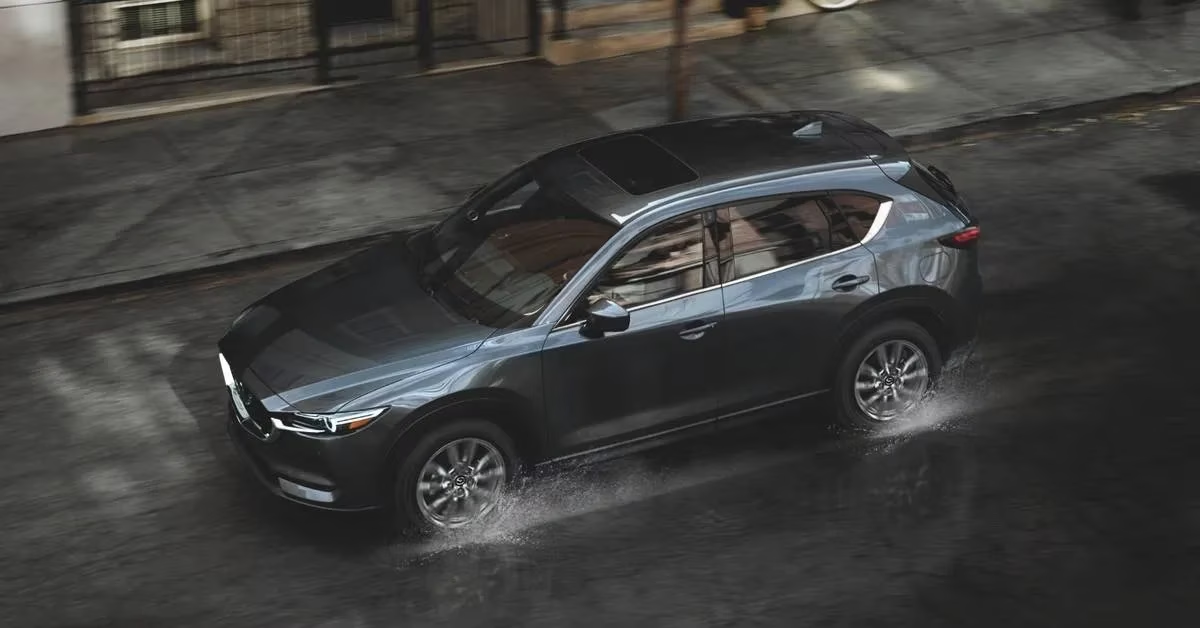
Let's start with the part that makes everyone's bank account breathe a sigh of relief: the price. My relationship with the CX-5 began like finding a twenty in last winter's coat—unexpected and delightful. A base model today still dances around the $26,000 mark, consistently undercutting the RAV4 by roughly a grand. That's not pocket change; that's a premium set of all-weather floor mats and a year's supply of car wash tokens. But the penny-pinching doesn't evaporate once you leave the dealership. The CX-5's fuel economy is a quiet marvel, returning a combined 28 MPG without breaking a sweat. Sure, the Toyota ekes out 30 MPG, a difference so minuscule it's like arguing over a single missing rice grain in a sushi roll. Over the course of a year, you'd need a spreadsheet and a magnifying glass to feel the financial pinch. In 2026, with fuel prices having performed more loop-de-loops than a stunt plane, the Mazda's parsimony is a long-term hug for your finances.
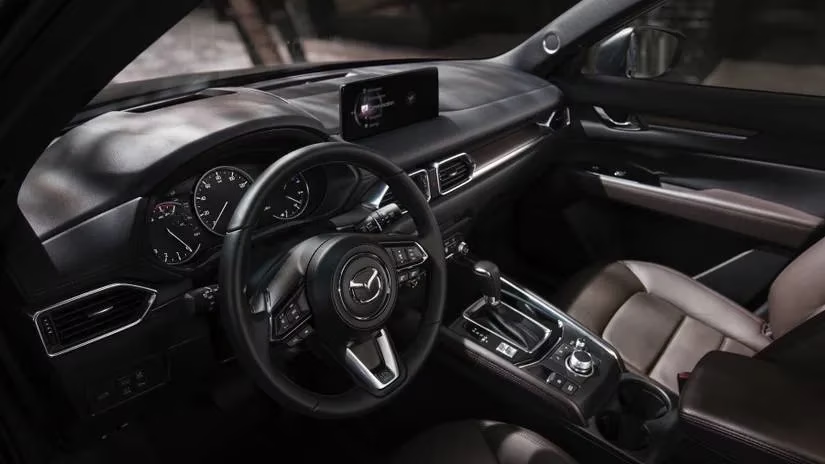
Step inside, and the equation becomes even rosier. Where most non-luxury Japanese interiors feel like a functional, if slightly sterile, office cubicle, the CX-5's cabin is the equivalent of a cozy, dimly-lit library with leather-bound books. The designers clearly lost sleep obsessing over stitching and soft-touch materials. And the tech? It's as standard as a morning coffee. Every trim level arrives armed with radar cruise control, blind-spot monitoring, keyless entry, and seamless Android Auto/Apple CarPlay integration. There's no hidden paywall for safety; Mazda treats blind-spot alerts not as a premium accessory, but as a birthright. Think of it as the crossover world's ethical hacker—always alerting you to dangers you never saw coming.
Cargo space is another chapter where the CX-5 writes its own poetry. With 30.9 cubic feet behind the rear seats and a cavernous 59.6 when you fold them flat, it swallows everything from IKEA hauls to a spontaneous camping trip's worth of gear. Yet, like a masterfully composed haiku, there's a deliberate constraint: rear legroom. It's not a stretch limo; tall passengers might need to negotiate knee real estate politely. But for daily duties, it's a shape-shifter that blends compact urban maneuverability with weekend-warrior practicality, much like a Swiss Army knife that's missing only the corkscrew—annoying only at specific, wine-involved picnics.
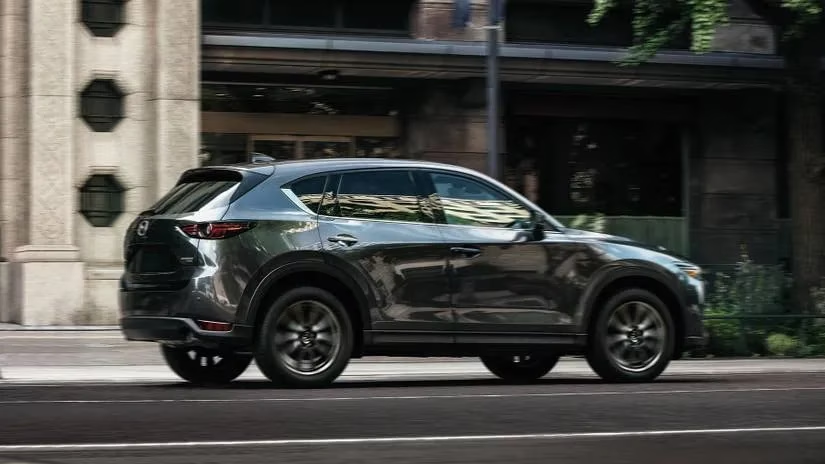
Now, let's talk about an unexpected party trick: towing. When I first heard a compact crossover could tow 2,000 pounds, I imagined it pulling a toy wagon, not a small camper. The CX-5's 2.5-liter SkyActiv-G engine, churning out a modest 187 horsepower and 186 lb-ft of torque, behaves like a beaver—busy, determined, and surprisingly effective at hauling loads. It is the automotive embodiment of a terrier with a big stick. If those numbers sound meek, you can opt for the turbocharged variant, which inflates output to a punchy 250 HP and 320 lb-ft of torque. That transforms the CX-5 from a diligent commuter into a stealthy back-road bandit, capable of towing small boats or jet skis while still slipping under the radar at the fuel station.
Here's where my argument crystallizes. Why not just buy a RAV4, which can tow 3,500 pounds and can be equipped with TRD-tuned suspension? Ah, the devil tap-dances in the details. Those RAV4 capabilities aren't standard; they're locked behind trim levels that shove the price tag north of $30,000. Suddenly, the playing field tilts. The CX-5 doesn't need to be the absolute best at any single chore—it's the all-rounder that refuses to nickel-and-dime you for basics. Choosing the Mazda is like picking the unassuming neighborhood café over the flashy chain: the coffee is just as good, the Wi-Fi is free, and nobody asks you to tip for a napkin. In 2026, when car prices appear to be written in monopoly money, a vehicle that respects your intelligence and your wallet becomes an instant icon.
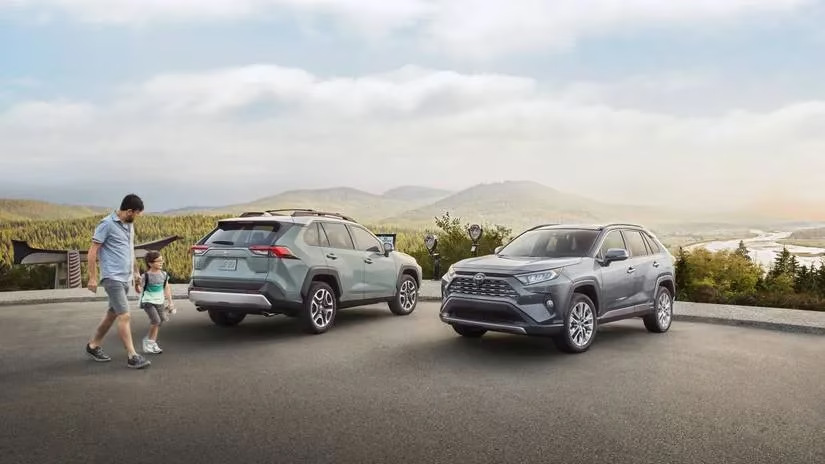
Thus, I crown the Mazda CX-5 as the reigning emperor of base-model Japanese crossovers. It's the quiet prodigy that doesn't scream for attention but consistently delivers more than expected. While the RAV4 remains a worthy adversary, often feeling like a sumo wrestler—immensely capable but built for a specific grandeur—the CX-5 is the judo master, using balance and intelligence to flip the competition. From its penny-sensible starting price to its standard safety suite and that little towing engine that could, the CX-5 in 2026 is proof that thoughtful engineering and genuine value never go out of style. If you're still on the fence, do your bank account a favor and test drive one. Just be prepared to fall for a crossover that feels less like an appliance and more like a well-worn leather jacket—comfortable, cool, and unexpectedly versatile.
Leave a Comment